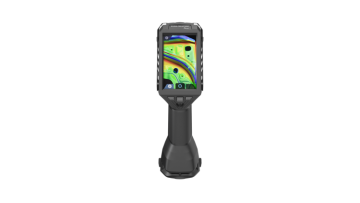
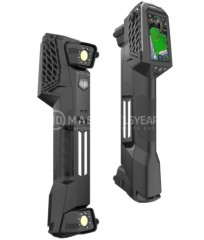
In modern manufacturing, many businesses still rely on manual measurement methods or handheld 3D scanning, resulting in slow inspection speed, human-dependent errors, and inconsistent data quality. As accuracy requirements increase and production volumes grow, these methods begin to show clear limitations. Inspecting complex components also becomes more difficult and time-consuming. Therefore, the demand for a fully automated scanning and inspection solution is becoming essential, and robot-mounted 3D scanning is considered a suitable alternative in industrial production.
1. What is Robot-Mounted 3D Scanning Technology? Structure of a Robot-Based 3D Scanning System
3D scanning is the process of capturing the geometric data of an object in space to create a digital 3D model.
When this technology is integrated with industrial robots or collaborative robots (cobots), the system can generate highly accurate digital models for manufacturing, inspection, and engineering analysis.
A standard robot-mounted 3D scanning system typically includes four main components:
Robotic Arm: Usually a 6-axis or 7-axis robot to ensure access to all complex and hard-to-reach areas of the object
3D Scanning Sensor (Scanner): Uses Laser technology (high accuracy on reflective surfaces) or Structured Light (fast data acquisition speed)
Point Cloud Processing Software: Converts millions of raw data points into mesh models or directly compares them with CAD files
Control & Synchronization System: Ensures that scanned data is accurately aligned with the robot arm’s position coordinates in real time
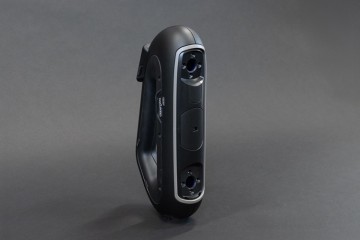
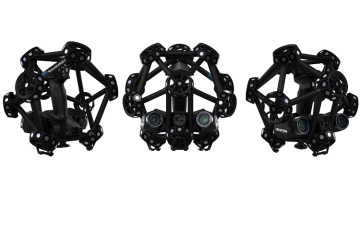
Currently, one of the most popular solutions is the robot-mounted Creaform MetraSCAN-R 3D scanner, known for its high accuracy, fast scanning speed, stable performance in factory environments, and easy integration into automated inspection systems.
Robot-mounted Creaform MetraSCAN 3D system
2. Workflow of a Robot-Mounted 3D Scanning System
This 3D scanning process is fully automated, eliminating human-related errors and typically consists of five main steps:
Step 1: The robot moves the scanner to the optimal position based on a pre-programmed path, ensuring correct distance, viewing angle, and full surface coverage
Step 2: The 3D scanning sensor captures the object’s surface data as a point cloud, recording geometric details such as dimensions, contours, and curvature
Step 3: The robot automatically adjusts its position and angle to perform multi-angle scanning, ensuring complete data capture and eliminating blind spots
Step 4: The software processes the data by merging multiple scan datasets, aligning them, and reconstructing a complete 3D model in mesh or CAD format
Step 5: The final data is exported in standard formats such as CAD, STL, or OBJ/PLY for engineering design, 3D printing, or quality inspection
3. What Are the Functions of a Robot-Mounted 3D Scanning System?
In modern manufacturing, robot-integrated 3D scanning systems act as “intelligent measurement eyes,” automating multiple processes from inspection to positioning and data reconstruction.
Automated measurement and quality inspection: Directly compares real products with CAD designs to detect dimensional deviations and surface defects such as warping or deformation, minimizing manual measurement
Object recognition and positioning: Accurately determines the position and shape of objects in 3D space, enabling robots to perform pick-and-place operations with high precision
Robot guidance and path planning: Provides spatial data for robots to plan motion paths, avoid collisions, and operate accurately on non-standard surfaces in machining, welding, painting, or assembly
Support for reverse engineering: Scans physical objects without original drawings to reconstruct CAD models for repair, improvement, or reproduction
A robot-mounted 3D scanning system automates multiple processes
4. Key Advantages Compared to Manual 3D Scanning
In practical measurement and quality inspection, robot-mounted 3D scanning demonstrates clear advantages over manual methods in terms of data consistency and system automation. Below is a detailed comparison:
Criteria
Manual 3D Scanning
Robot-Mounted 3D Scanning
Repeatability
Low (depends on operator skill and condition)
Absolute (robot path is fixed and consistent 100%)
Speed
Slow, requires setup time and target placement
Extremely fast, continuous 24/7 scanning
Coverage
Limited by human reach and height
Flexible, capable of scanning very large or very small objects
5. Real-World Applications of Robot-Mounted 3D Scanning Systems
Robot-mounted 3D scanning systems are widely applied across various industries thanks to their high accuracy, automation capabilities, and adaptability in complex environments.
Manufacturing Industry: Used for inspecting mechanical components, checking molds, and supporting automotive and electronic production with high accuracy and speed
Quality Inspection (QA/QC): Compares actual products with CAD designs, detects deviations in real time, and enables full inspection across production lines
Aerospace: Supports inspection of complex components such as aircraft wings and turbines, ensuring compliance with strict technical standards
Logistics & Autonomous Robotics: Used to build 3D warehouse maps, enabling AGV/AMR robots to navigate accurately and optimize routes
Medical & Dental: Supports scanning dental structures, designing precise implants, and enabling personalized surgical applications with high accuracy
Overall, robot-mounted 3D scanning is becoming a core solution in automated measurement and digital manufacturing, helping businesses improve accuracy, optimize inspection speed, and build comprehensive 3D data models across industries. This technology not only replaces manual methods but also paves the way for smart factories and intelligent manufacturing in the future.
Currently, 3D MASTER is an official distributor of Creaform in Vietnam with over 10 years of experience, providing full demo systems, robot integration solutions, and a highly skilled technical team ready to support businesses in implementing 3D scanning applications effectively and optimally.
.jpg)
.jpg)